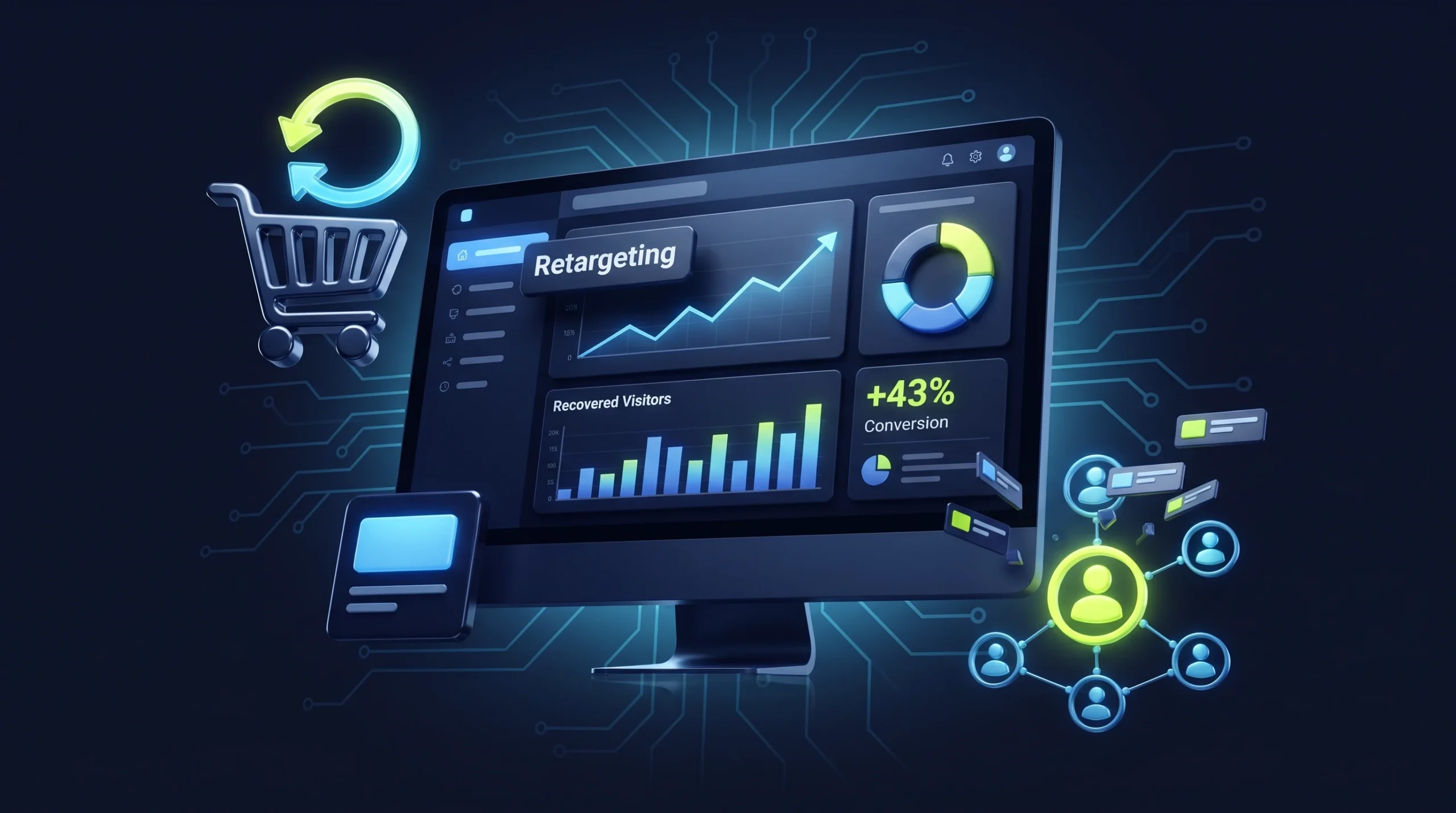
⚡ Quick answer: 98% of website visitors don’t buy on their first visit — that’s not a marketing failure, it’s just normal behavior from someone still comparing options. Retargeting brings those people back: retargeted visitors convert 43% more often than cold audiences, and abandoned-cart recovery jumps from 8% to 26% with retargeting in place. The catch: don’t show the same five ads for a month straight — past 5-7 impressions a week, people stop seeing an ad and start feeling followed.
Small business owners often look at a low site conversion rate and conclude “the ads aren’t working” or “the site is bad.” Most of the time, what’s actually missing is the second touch — someone visited, looked around, left to compare two competitors, and simply forgot about you within a couple of days without a reminder.
Average first-visit conversion sits around 0.5-1.5%. For a returning visitor, that same number jumps to 2-5% — three to five times higher. The difference isn’t that the site suddenly got better in a week. It’s that the person has already seen the brand once, and it’s usually the second or third encounter that turns into a decision, not the first.
Per Google’s own data, conversion likelihood at the third touchpoint runs roughly 43% higher than at the first. In our own work, clients running retargeting alongside their main ad campaign almost always ask the same question a month in: “why are new leads suddenly coming from people who apparently visited the site ages ago and disappeared.” The answer is simple — they finally saw the reminder at the right moment.
| Metric | Without retargeting | With retargeting |
|---|---|---|
| Visitor conversion likelihood | baseline | +43% |
| Ad CTR | 0.07% (standard display) | 0.7% (10x higher) |
| Cart-abandonment recovery | 8% | 26% |
| Brand recall | baseline | +57% |
Cart abandonment is its own pain point. On average, around 70% of people add something to a cart and leave without paying. Reasons vary: they wanted to think it over, they’re comparing the price elsewhere, or a phone call just pulled them away. Dynamic retargeting — showing the exact item left in the cart instead of a generic store ad — recovers the most from this group, which is exactly why dedicated platforms build separate “abandoned cart” campaigns rather than one blanket campaign for every visitor.
A small snippet of code goes on the site (a Meta pixel or a Google Ads tag) — it doesn’t collect personal data, it just remembers that a visit happened and which pages the browser looked at. The ad platform then builds an audience from those visitors and shows them ads on other sites or in their social feed while they’re scrolling something else entirely.
Technically, none of that is hard. The harder part is splitting that audience into groups instead of showing everyone the same ad.
The most common approach for small businesses is a single audience — “everyone who visited in the last 30 days” — shown one generic “come back” ad. It works, but far worse than it could, because someone who just glanced at the homepage and someone who added an item to their cart and didn’t pay are at completely different stages of the decision.
A working split looks like this: people who only browsed the catalog get an ad built around social proof or reviews, since they’re not yet convinced the store itself is trustworthy. People who added to cart get dynamic ads showing that exact product, maybe with a small discount or free shipping as a final nudge. People who already bought once get an entirely different campaign, built around a repeat purchase or upsell — not the same “buy for the first time” pitch.
Three groups, three different messages — and that distinction, not the mere fact of running retargeting at all, is usually what determines whether a campaign actually pays for itself or just runs quietly in the background with nothing to show for it.
On one of our own projects, a client first launched exactly one blanket audience — all visitors over 30 days — with a single “come back, we have discounts” ad, and the first couple of weeks looked like the campaign simply wasn’t worth the spend. Lead cost on that campaign barely justified running it at all, and the client was ready to write retargeting off as “another channel that didn’t work.” After splitting into the three groups above with a distinct message for each, lead cost from the “abandoned cart” audience specifically dropped by roughly half compared to the blanket campaign — simply because those people had already almost bought once, and didn’t need convincing that the store was trustworthy, just one final push.
This is where business owners get it wrong in both directions. Too few impressions, and someone doesn’t see the ad in the moment they’re actually ready to come back. Too many, and the brand starts reading as a stalker, not a reminder.
A working benchmark: 3-5 impressions a week for an audience that simply browsed the site, and a bit more — up to 2-3 impressions a day for 7-14 days — specifically for cart-abandoners, since their decision window is much narrower.
Past 5-7 impressions a week, researchers consistently see a clear drop-off — CTR falls, and negative brand sentiment rises. Put simply, past that point you’re paying to annoy people who already said no. Frequency capping is a setting available on every ad platform, and it’s almost always worth setting manually rather than leaving it on “automatic” by default.
This is a setting every platform has, but it almost always stays on the default — and the default doesn’t always fit the business.
It’s the retargeting window: how many days after a visit someone stays in the audience for ad delivery.
| Window | Best fit |
|---|---|
| 7-14 days | Abandoned cart, impulse purchases with a short decision cycle (apparel, accessories, food) |
| 30 days | Standard catalog-visitor audience — the most common baseline |
| 60-90 days | Products and services with a longer decision cycle (furniture, home renovation, online courses) |
| 180 days | B2B and high-ticket services where a decision takes months, not days |
Getting this wrong in either direction costs money. Too short a window on an expensive B2B service, and you lose someone still weighing the decision simply because they dropped out of the audience before they were ready. Too long a window on sneakers or pizza, and the budget goes toward people who settled the question somewhere else long ago and forgot about you entirely.
Retargeting doesn’t have to mean paid ads. If you already have someone’s email — from a signup form, an account registration, or a checkout attempt — an abandoned-cart email works as your own free retargeting channel, one that doesn’t depend on an ad auction at all.
The numbers here are striking: per Klaviyo’s analysis, abandoned-cart emails get opened by 40-45% of recipients — two to three times higher than a standard email blast. Conversion from that email averages around 10.7%, and each email sent generates roughly $3.65 in revenue on average. The best-performing flows push that up to $28.89 per recipient — and the real difference isn’t the email itself, it’s how fast it goes out: an email sent within the first hour after someone closes the tab on their cart lifts conversion by 20% compared to one that arrives the next day.
The two platforms together account for over 80% of all retargeting ad spend worldwide — and that’s not an accident, each brings something different. Google Remarketing catches people across its partner network and in search, when they’re searching for something similar again. Meta (Facebook/Instagram) works through the visual feed — and that’s exactly where dynamic retargeting with a product photo performs especially well, since the image format is native to the platform anyway.
We already covered the overall budget for both channels in how much Google Ads and Facebook Ads actually cost — retargeting there usually costs less than cold-audience targeting, since the auction is more competitive for new people, not for those who already know the brand.
A business launches retargeting, sees decent results in the first week or two, and then forgets about the campaign for months — the same audience keeps seeing the same ad with the same discount until it’s worn down to nothing. An ad that worked in January reads as background noise the brain has learned to ignore by March.
Refreshing creative roughly every 3-4 weeks for active campaigns is worth doing — not because the old ad broke technically, but because the same audience has seen it dozens of times and stopped paying attention.
The second thing that often gets missed is excluding people who already bought. Someone who just paid for an order and then spends a week seeing ads for that exact same product doesn’t come away with the best impression of the brand.
CTR and impression counts look nice in a report, but on their own they say nothing about profit. The metric that actually matters is lead cost from the retargeting audience compared to lead cost from a cold audience — and, if there’s a technical way to track it, lead cost broken out by each of the three segments above. If cart-abandonment retargeting costs more than cold ads, something’s off with the setup or the message itself, not with the idea of retargeting.
The second number worth checking monthly is the share of ad budget going to retargeting compared to the share of leads it brings in. A healthy ratio for most small businesses runs retargeting at 15-25% of the ad budget while it delivers a noticeably larger share of leads than that percentage — simply because competition for a warm audience’s attention is lower than competition for a cold one.
Before paying for retargeting, it’s worth checking three things. First, has the pixel/tag been installed long enough to accumulate a real audience — a campaign running on 50 people technically works, but won’t show anything statistically meaningful. Second, is there at least a basic split of the audience by behavior, rather than one blanket group for everyone. Third, is there budget set aside for regularly refreshing creative, not just the initial launch — otherwise the effect fades on its own within two or three months.
In our own work, retargeting rarely performs well as a standalone campaign in a vacuum — the best results come when it layers on top of an already-running main ad campaign or organic SEO traffic, simply nudging people who are already close to ready, instead of trying to find a new audience from scratch on its own.
If you already have traffic coming to your site but first-visit conversion is low, and there’s no budget yet for a second reminder — take a look at how we run Google Ads or targeted Facebook and Instagram advertising, and we’ll build retargeting in as part of the overall strategy, not a separate checkbox in a report.
Обговорюємо саме цю послугу у вашому проєкті?
Google Ads