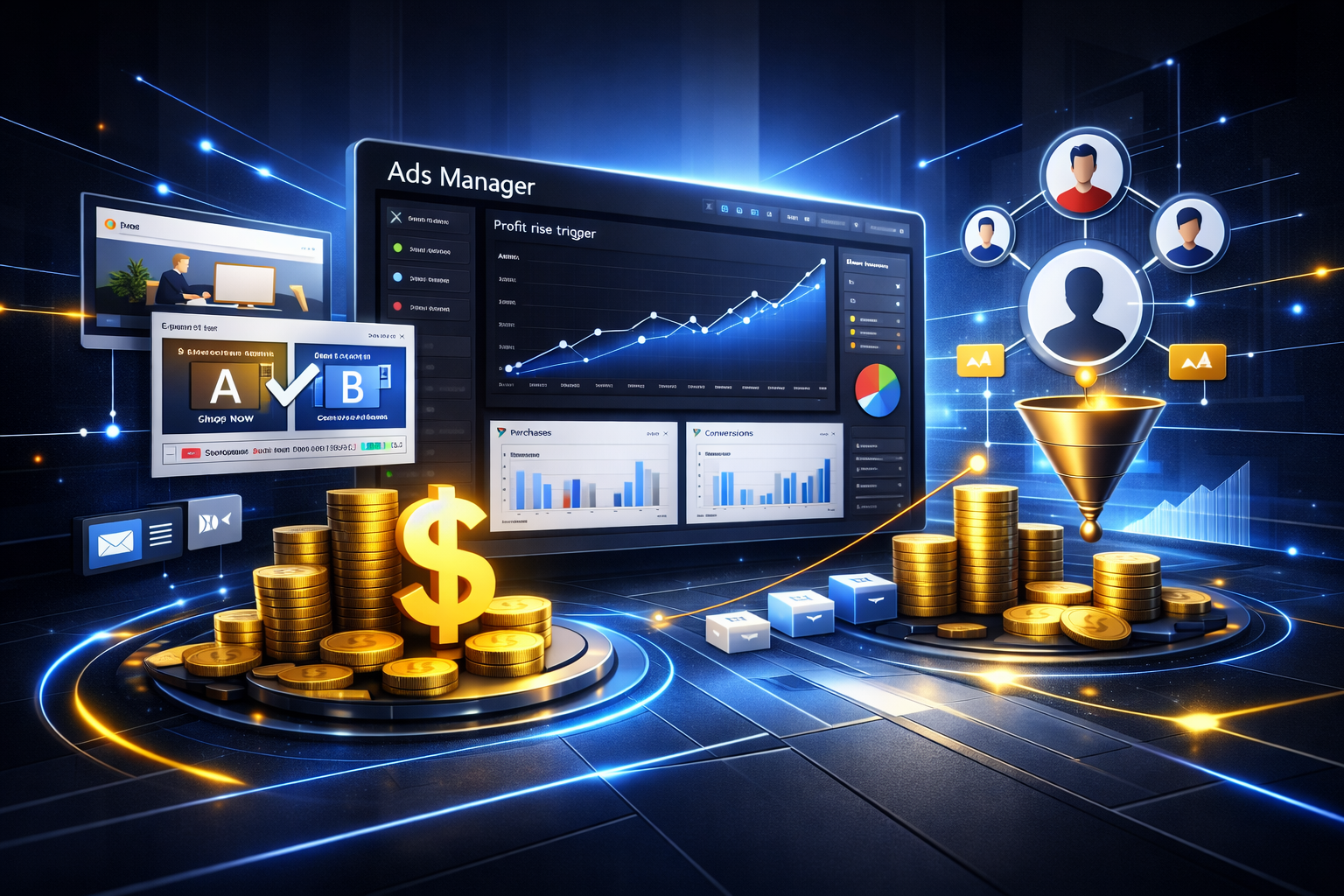
The era of “cheap clicks” and simply hitting the blue button under a post is over. Today, Facebook advertising isn’t just “posts in a feed.” With an audience of over 3.98 billion monthly active users (per Meta Q4 2025 data), the platform has become the world’s most powerful predictive analytics system. In 2026, media-buying success doesn’t depend on budget — it depends on the quality of the signals you feed the machine learning algorithm.
The biggest marketing mistake is treating Facebook advertising like a lottery. In reality, it’s a tool for working with the economics of attention. A professional ad account — Meta Ads Manager — lets a business go beyond organic reach, which for business pages today rarely exceeds 2-3%.
Professional advertising isn’t just “impressions” — it’s algorithmic buying of conversions. The system processes billions of signals and selects the exact people whose purchase intent is highest at that moment.
In short: professional Facebook advertising is algorithmic buying of target actions at the lowest possible price. The system analyzes thousands of data points (interests, purchase history, scroll time, video engagement) and shows your ad only to those most likely to convert.
It’s not simply a matter of who pays more. Meta uses a Total Value formula that factors in three variables:
Example: Brand “A” bids $10 per lead, but has low-quality creative. Brand “B” bids $5, but its video gets watched to the end. Meta will choose Brand “B,” because its ad is more valuable to the user.
The higher the combined value, the lower your cost per 1,000 impressions (CPM), and the more premium placements (Reels, Stories, Messenger) you’ll get.
For steady growth, your sales funnel needs to be predictable. The Meta ad platform provides three fundamental advantages for this:
In the following sections, we’ll break down how to set up this mechanism so every dollar you spend comes back as real profit, not just empty views.
Every Facebook or Instagram business page owner sees a tempting blue “Boost” button under their posts every day. Meta does everything it can to get you to click it within seconds. But here’s the catch: that button is designed to get you spending money on “social approval” (likes and shares), while the professional Meta Ads Manager is designed to get you earning.
Let’s look at the technical gap between these two approaches and figure out why the professional dashboard is the only real path to scaling.
This is a simplified, “lite” version of the ad dashboard. It’s perfect for influencers who just want to boost engagement on a photo, but it severely limits a business.
This is a full professional workstation. It’s where complex funnels get built and deep analytics happen.
Comparison table: The “Boost” button vs. Ads Manager
| Feature | The “Boost” Button | Meta Ads Manager |
| Business Goals | Only 2-3 (reach, messages) | All 6 core objectives (from awareness to sales) |
| Targeting | Basic (age, gender, city, 1-2 interests) | Deep: interests, behavior, Custom and Lookalike audiences |
| Placements | Automatic (no choice available) | Full manual or automatic control (Advantage+) |
| Budget Optimization | At a single-post level | Flexible: campaign level (CBO) or ad set level (ABO) |
| Creatives | Existing post only | Special ad formats, dynamic creative, carousels |
| Analytics | Surface-level (clicks, likes) | Deep: ROAS, CPA, CTR, content views, Pixel/CAPI events |
Netloria expert insight: The difference between the “Boost” button and a professional Ads Manager is the difference between a toy and a fighter jet. In the dashboard, you control bidding strategies, optimize budget at the campaign level (CBO), and implement the Conversions API (CAPI). The latter is critical for sending data directly from your server, bypassing browser blocking and keeping signal quality intact in 2026.
In 2026, the approach to finding customers on social media has fundamentally changed.
A successful strategy today isn’t built on technical checkboxes in a dashboard — it’s built on a deep understanding of human psychology and business analytics.
To an experienced strategist, a target audience isn’t a dry demographic sheet describing “women 25-45 with average income.” It’s a living community of people united by specific problems, needs, and behavior patterns. For ads to work, we need to understand not who these people are, but why they should pay attention to your product right now. Today, a successful strategy is built not on technical settings, but on understanding user intent.
Case study: A CRM company selling to architects used to target based on an “Architecture” interest. Switching to Broad Targeting (wide reach, no interest filters) with an emphasis on the profession’s pain points in video cut lead cost by 30%. The algorithm found the right professionals on its own, based on how they reacted to the content.
We segment audiences by “temperature”:
The paradox: Creative has become the main filter. If the visuals hit your audience’s pain points, the algorithm will find buyers on its own through Broad Targeting. But ad success is inseparable from the landing page.
High traffic costs leave no room for error in UX/UI design. If your landing page isn’t optimized for mobile or has confusing navigation, you’re simply subsidizing Meta without getting conversions. Every second of site delay reduces the likelihood of purchase by 7-10%.
That’s exactly why Netloria’s web design studio, when building comprehensive promotion strategies, focuses on creating a cohesive ecosystem. We don’t just “run targeting” — we design the customer journey, where professional website design becomes the main tool for turning clicks into real sales. Only syncing a strong ad offer with flawless technical execution on the site delivers a consistently high ROAS.
When you launch a campaign, you get access to Meta’s entire inventory:
A successful Facebook ad campaign isn’t a chaotic pile of ads — it’s a clear, hierarchical structure. For your Facebook ads to be manageable and scalable, it’s important to understand what each level of settings is responsible for. Here’s the architecture of a professional campaign:
| Hierarchy Level | Main Function | Key Settings |
| 1. Campaign | Choosing a business strategy | Defining the goal (lead generation, sales, traffic) and enabling Advantage+ budget (CBO). |
| 2. Ad Set | Logic and targeting | Choosing your target audience (Lookalike, retargeting, interests), choosing placements (Reels, Stories), budget, and schedule. |
| 3. Ad | Visual communication | Creative (video/static), ad copy, headline, call-to-action button, and UTM tags. |
This structure lets you run clean A/B tests. For example, you can create a single campaign with a “Sales” objective, but run two different ad sets inside it: one for “warm” retargeting (people already familiar with the brand), and another for a “cold” interest-based audience. This helps you pinpoint exactly where customer acquisition cost is lowest, and where it’s worth investing more.
Remember: when you launch an ad, the system enters a “learning phase.” The algorithm analyzes the first 50 conversions to figure out which type of user responds best to your offer. If you make chaotic changes to your settings during this phase, learning resets, and your return on spend can drop significantly.
Netloria expert insight: The most common beginner mistake is trying to control everything at the individual-ad level. The professional approach is to give the algorithm room to maneuver. Use the Facebook Pixel and the Conversions API so the system sees real results, not just clicks. Only with complete data can Meta effectively optimize your spend.
We recommend focusing on strategy — that’s what turns technical “clicks” into real money in your pocket.
Meta’s algorithms have become so sophisticated they know user intent better than users do themselves. To achieve a stable ROAS and scale without spiking your cost per lead, we recommend implementing four fundamental principles:
Fact: After the iOS 14.5 update, the standard Pixel loses up to 30% of its data. CAPI recovers that data, teaching the algorithm to see real buyers.
Every format in Meta Ads has its own “superpower.” To make sure your Facebook ads generate profit instead of just spending money, at Netloria we use the following selection matrix:
| Ad Format | Best Suited For | Main Advantage | Funnel Stage (Targeting) |
| Image & Video (Reels/Stories) | Building awareness and quick emotional sales. | The lowest cost per 1,000 impressions (CPM) and high engagement via Reels. | Cold audience (brand introduction) |
| Carousel Ads | E-commerce purchases or step-by-step service explanations. | Encourages users to interact (swiping), which increases brand contact time. | Warm audience (comparing options) |
| Lead Ads | Collecting inquiries directly on the platform (no site visit needed). | Maximum lead generation thanks to auto-filled fields pulled from the user’s profile. | Hot audience (direct service request) |
| Dynamic Catalog (Advantage+) | Automatically showing products a user has shown interest in before. | The highest ROAS and offer personalization for each specific customer. | Retargeting (bringing customers back to the site) |
| Collection (Instant Experience) | Creating a full mobile “storefront” right inside Facebook/Instagram. | Instant loading and full visual immersion in the product, with no need to wait for the site. | Warm/Hot (encouraging purchase) |
In modern media-buying strategy, we recommend using a combination of formats. For example, to attract new people, UGC-style video content (Reels) works best, where a real person talks about the product’s benefits. And for people who’ve already visited your site, we turn on a dynamic catalog that automatically “follows” the customer with the exact product they were browsing.
Netloria expert insight: Remember “banner blindness.” Even the most successful carousel will start showing worse conversion after 2-3 weeks. To keep your CPA (cost per action) low, you need to regularly refresh creatives and test different approaches. Meta’s AI loves variety: the more formats you give the algorithm to test, the faster it finds your ideal combination for profit.
The technical part of choosing a format is only half the job. The real “magic” of numbers and analytics begins once data tracking is properly set up.
Facebook advertising isn’t a lottery you can “try your luck” at. It’s a complex mathematical model that only works for you with a systematic approach. You can keep hitting the blue button, collecting “likes” from people who will never become your customers. Or you can turn Meta Ads into a powerful asset that generates profit 24/7.
We don’t just set up targeting — we build an ecosystem: from implementing the Conversions API for precise tracking to creating creative that hits the mark exactly. We know how to move your campaign out of the learning phase and scale your profit without the risk of burning through your budget.
Обговорюємо саме цю послугу у вашому проєкті?
Facebook / Instagram Ads